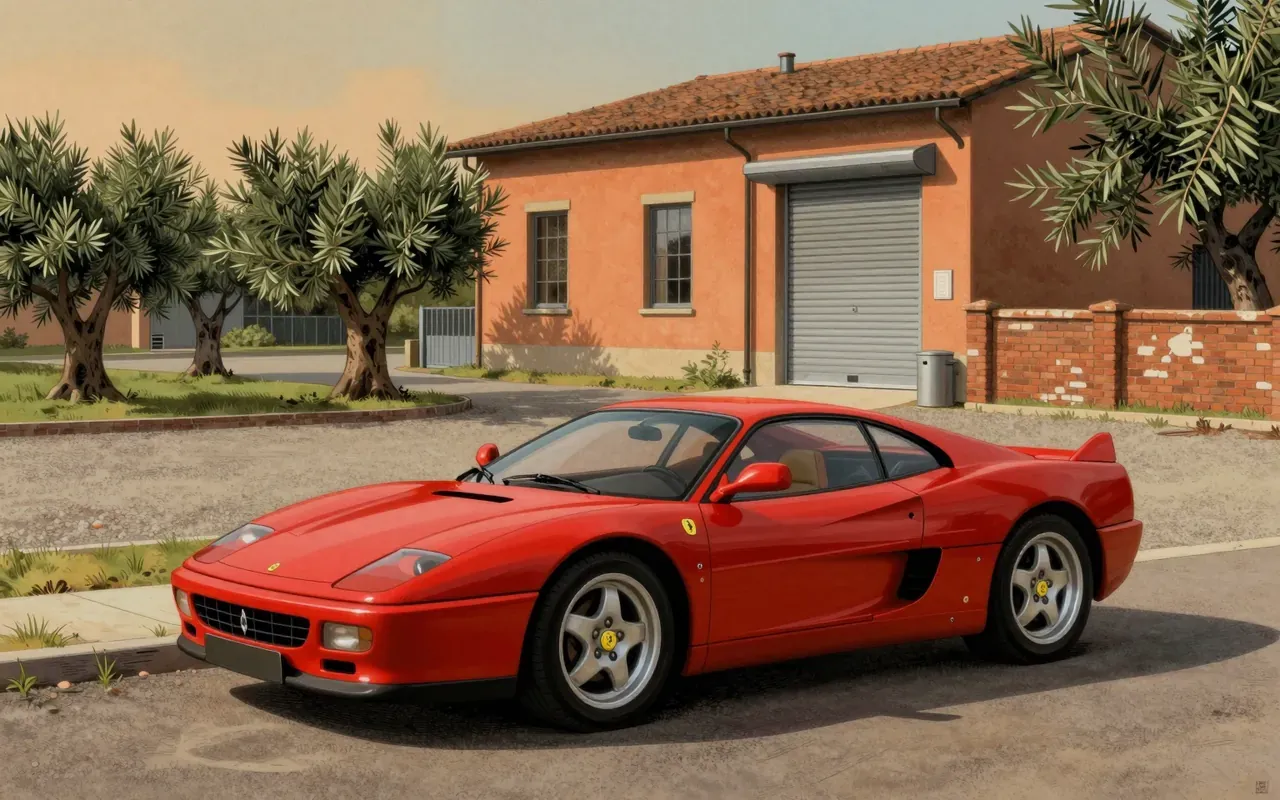
The Ferrari 456 is a front-engine grand tourer produced by Ferrari from 1992 to 2003. Designed by Pietro Camardella at Pininfarina and introduced in October 1993, it succeeded the 412 as Ferrari’s V12-powered four-seater. Its design drew heavy inspiration from the 365 GTB Daytona. It was offered in GT (six-speed manual) and GTA (four-speed automatic, from 1996) trims. The automatic transmission was Ferrari’s second and last conventional hydraulic automatic with torque converter. Its 5.5 L 65° V12 engine was derived from the Dino V6 — not the 60° V12s used in the 412 and Daytona.
It is Ferrari’s final front-engine V12 four-seater built on the 412’s mandate — but with new architecture and intent.
2:18
Daytona Reimagined
Camardella’s design references the Daytona, but reinterprets it for a wider, heavier, more practical machine.
3:42
The Last Torque Converter
The GTA’s four-speed automatic is Ferrari’s second and final torque-converter transmission — a deliberate choice for smoothness over speed.
5:08
A Different Kind of V12
Its 5.5 L 65° V12 breaks from Ferrari tradition — derived from the Dino V6, not the 60° lineage of the Daytona or 412.
6:12
Two Transmissions, Two Missions
GT means six-speed manual; GTA means four-speed automatic — a hard split that defines the car’s dual personalities.
7:12
The Analog Bridge
Built from 1992 to 2003, it bridges Ferrari’s analogue past and digital future — but never tries to be both.
3 more chaptersFewer chapters
Worth your time?
Yes. Drive the whole thing.
3.5/ 5
What works
coherent front-engine GT identity
integration of large V12 into four-seat cabin
long-distance comfort with mechanical clarity
What does not
mid-engine balance
dual-clutch transmission
digital responsiveness
lightweight dynamics
Drive it if
drivers who prioritise composed high-speed cruising
collectors interested in the end of Ferrari’s torque-converter era
Skip it if
those seeking sharp turn-in
those expecting modern infotainment
Who should drive it, and who should skipHide who it is for
The written brief1 min read
What the car is and where it came from
The Ferrari 456 is a front-engine grand tourer produced by Ferrari from 1992 to 2003. It was designed by Pietro Camardella at Pininfarina and introduced in October 1993. It succeeded the 412 as Ferrari’s V12-powered four-seater.
How it works, in terms someone would actually use
It is a front-engine grand tourer. It seats four. It uses a 5.5 L 65° V12 engine derived from the Dino V6. It offers two transmissions: a six-speed manual (GT) or a four-speed automatic with torque converter (GTA, from 1996).
What it gets right
It establishes a coherent front-engine GT identity. It integrates a large V12 into a four-seat cabin without compromising rear visibility or boot space. It delivers long-distance comfort with mechanical clarity — especially through the manual gearbox and hydraulic steering.
What it does not
It does not offer mid-engine balance. It does not use a dual-clutch or automated manual transmission. It does not depart from Pininfarina’s front-engine GT formula. It does not share its engine architecture with the 412 or Daytona.
What it changed
It replaced the 412 as Ferrari’s V12 four-seater. It introduced Ferrari’s last conventional hydraulic automatic with torque converter. It shifted design language toward Daytona homage while abandoning the 60° V12 layout for a 65° unit derived from the Dino V6.
Who it is for, and who it is not
It is for drivers who prioritise composed high-speed cruising over agility. It is for collectors interested in the end of Ferrari’s torque-converter era. It is not for those seeking sharp turn-in, lightweight dynamics, or modern infotainment.
Is it worth your time
Yes — if you want to understand Ferrari’s pivot from analogue tradition to modern usability. No — if you expect driver engagement like a mid-engine sports car or digital responsiveness like a post-2000 GT.