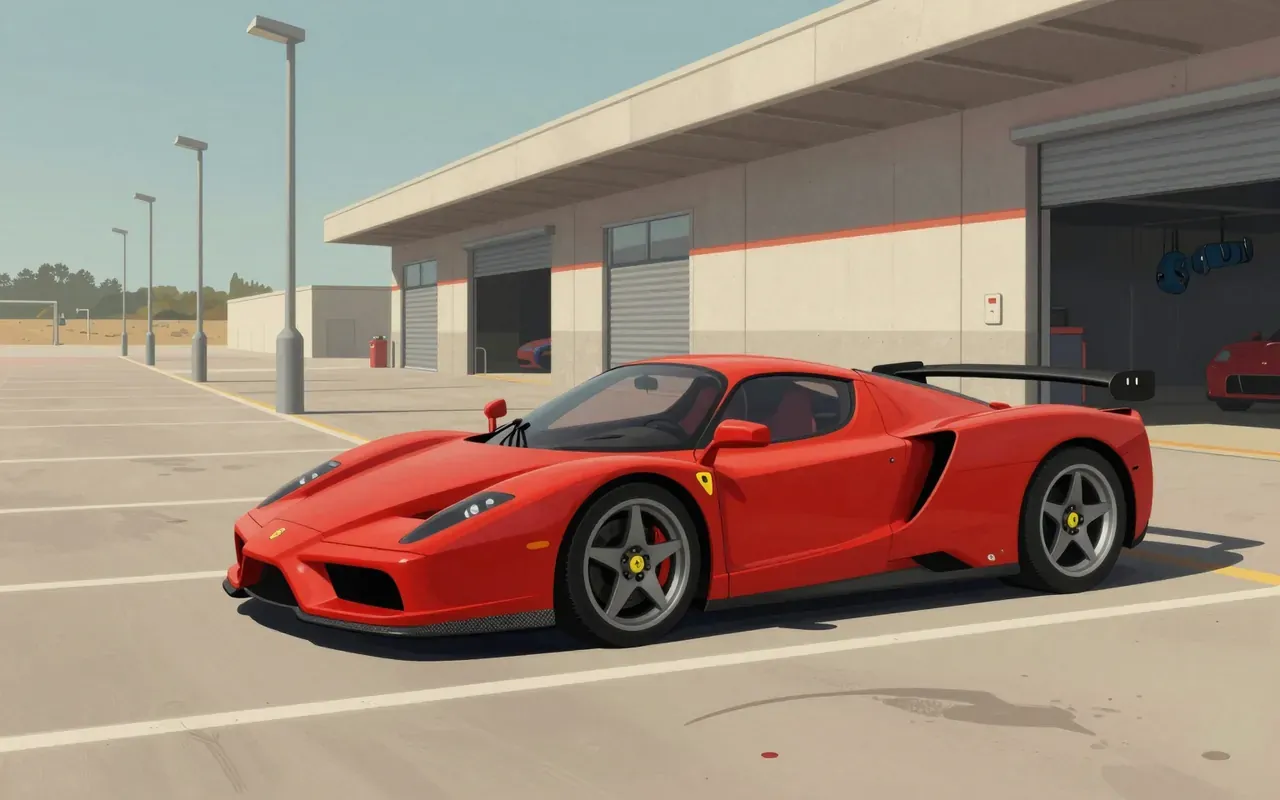
A Formula One lab experiment made legal — brilliant, brutal, and utterly uninterested in you.
The Ferrari Enzo is a mid-engine sports car developed by Ferrari in 2002, named after Enzo Ferrari, and designed by Ken Okuyama while at Pininfarina. It uses a naturally aspirated 65° V12 engine, rear mid-engine/rear-wheel-drive layout, and an automated manual F1 gearbox. Production spanned 2002–2004 with 498 units built. It was developed using Formula One technology including a carbon-fibre body, automated-shift manual transmission, ceramic composite disc brakes, and active aerodynamics. Its F140 B V12 engine was the first of a new generation for Ferrari. It was announced at the 2002 Paris Motor Show with a limited production run of 399 units, later increased to 498. Ken Okuyama designed and supervised its design at Pininfarina before becoming Creative Director there in 2004. In 2022, he was arrested for speeding in an Enzo at 88 km/h over the limit.
It is not a tribute car — it is a functional statement of intent, named after Enzo Ferrari and launched at the 2002 Paris Motor Show.
2:18
How it works
Its layout, transmission, and materials are borrowed directly from Formula One — but adapted for road use with active aerodynamics and ceramic brakes.
4:00
What it keeps pure
The naturally aspirated 6.0 L V12 and F1 gearbox define its character — no turbos, no hybrids, no dual-clutch smoothing.
5:30
How many exist
Only 498 were built — 99 more than the original plan — making it rare, but not mythical by scarcity alone.
Worth your time?
Yes. Drive the whole thing.
4.5/ 5
What works
It places the driver at the centre of a focused, track-derived feedback loop.
The carbon-fibre chassis delivers rigidity.
The F1 gearbox delivers rapid, repeatable shifts.
The active aerodynamics serve a clear purpose: downforce without fixed drag penalties.
What does not
It does not offer driver-adjustable suspension damping.
It does not use forced induction or electric assistance.
It does not prioritise cabin ergonomics, visibility, or low-speed drivability.
Drive it if
It is for collectors and engineers who value uncompromised mechanical intent over comfort or convenience.
It is not for drivers who need visibility, ease of ingress/egress, or adaptability to urban traffic.
Skip it if
It is not for drivers who need visibility, ease of ingress/egress, or adaptability to urban traffic.
The written brief1 min read
What the car is and where it came from
A mid-engine sports car developed by Ferrari in 2002, named after Enzo Ferrari, and designed by Ken Okuyama while at Pininfarina. It was built using Formula One technology and announced at the 2002 Paris Motor Show.
How it works, in terms someone would actually use
It uses a naturally aspirated 65° V12 engine mounted longitudinally behind the driver. The F1 gearbox is an automated manual with paddle shifters and LED gear-change prompts on the wheel. The car has a rear mid-engine, rear-wheel-drive layout and active aerodynamics.
What it gets right
It places the driver at the centre of a focused, track-derived feedback loop. The carbon-fibre chassis delivers rigidity. The F1 gearbox delivers rapid, repeatable shifts. The active aerodynamics serve a clear purpose: downforce without fixed drag penalties.
What it does not
It does not offer driver-adjustable suspension damping. It does not use forced induction or electric assistance. It does not prioritise cabin ergonomics, visibility, or low-speed drivability.
What it changed
It proved that active aerodynamics and carbon-fibre monocoque construction could be packaged into a road-legal production car without hybrid or turbocharging. It set a template for Ferrari’s next generation of V12 flagship cars.
Who it is for, and who it is not
It is for collectors and engineers who value uncompromised mechanical intent over comfort or convenience. It is not for drivers who need visibility, ease of ingress/egress, or adaptability to urban traffic.
Is it worth your time
Yes — if you need to understand how Formula One thinking reshaped road-car architecture in the early 2000s. No — if you seek usability, daily refinement, or evidence of evolution beyond its own moment.