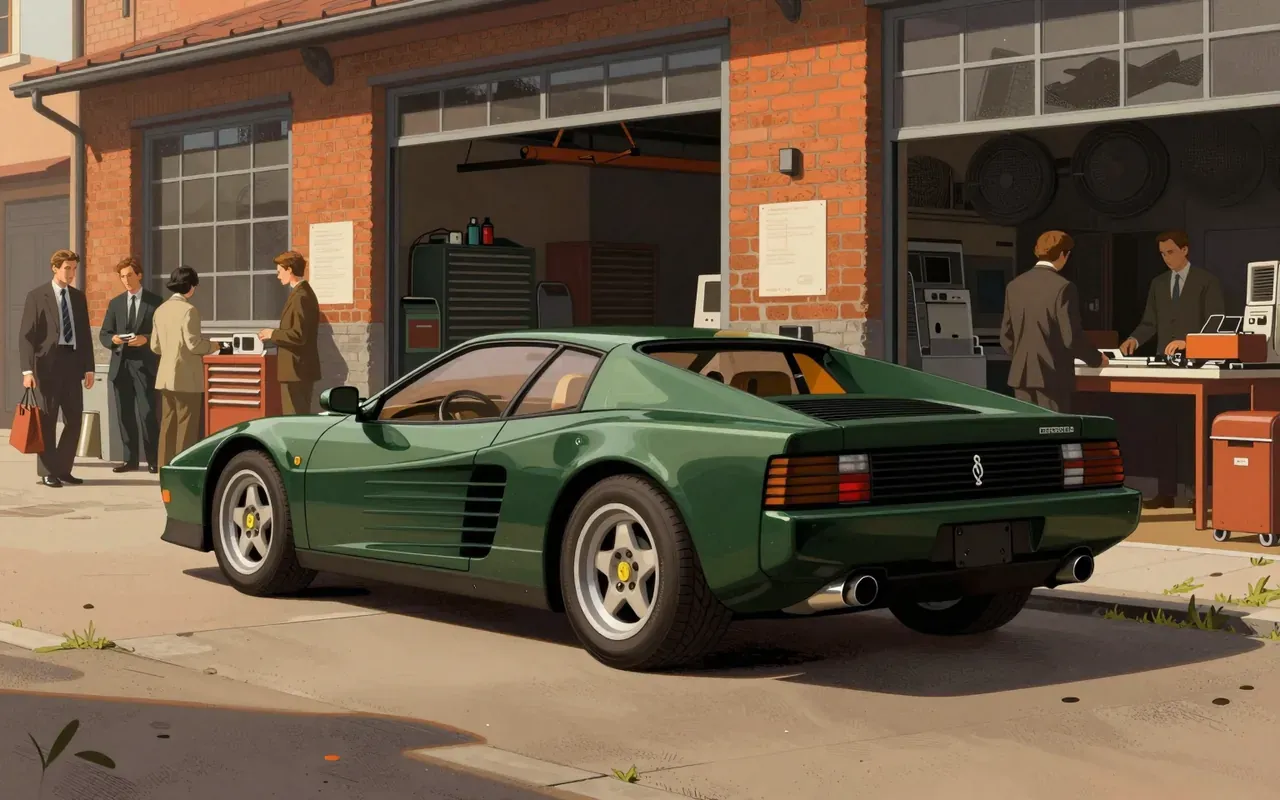
Ferrari built the Testarossa not to thrill drivers—but to stop the engine from cooking the gearbox.
The Testarossa is a Pininfarina-designed, two-door coupé introduced in 1984 as the successor to the Berlinetta Boxer. It features a 4.9 L flat-12 engine and rear mid-engine/RWD layout. Production ran from 1984 to 1991, followed by the 512 TR and F512 M until 1996. Nearly 10,000 Testarossa-series cars were produced. It was developed to resolve thermal and packaging issues of the 512 BBi and is distinguished by its side strakes, twin rear radiators, and aerodynamic efficiency. Designers included Diego Ottina, Guido Campoli, Ian Cameron, and Emanuele Nicosia. It is a cultural icon of the 1980s, popularised by Miami Vice and Out Run.
collectors valuing cultural resonance over driving purity
Skip it if
drivers seeking modern mid-engine balance
enthusiasts who judge by throttle response alone
buyers expecting daily usability
The written brief1 min read
What the car is and where it came from
A Pininfarina-designed, two-door coupé. Successor to the Berlinetta Boxer. Introduced in 1984. Built around a 4.9 L flat-12 engine and rear mid-engine/RWD layout.
How it works, in terms someone would actually use
The driver sits ahead of a rear mid-engine flat-12, with the gearbox mounted behind the engine. The weight distribution is 40% front, 60% rear. A five-speed manual transmission is the only option.
What it gets right
It resolves the 512 BBi’s thermal faults. Its width accommodates the flat-12 without compromising cabin space. Its aerodynamic efficiency supports high-speed stability.
What it does not
It does not offer agility or feedback comparable to lighter, more centrally balanced mid-engine cars. It does not prioritise driver engagement over presence or thermal management.
What it changed
It shifted Ferrari’s flagship from a cramped, overheating Berlinetta Boxer layout to a wider, more stable platform with twin rear radiators and side strakes for airflow.
Who it is for, and who it is not
It is for those who value engineering intent over immediacy—people curious about how form follows function in extreme packaging constraints. It is not for drivers seeking tactile precision or compact responsiveness.
Is it worth your time
Yes—if you want to understand how Ferrari solved heat and packaging in the 1980s, not how it drove like a modern supercar.