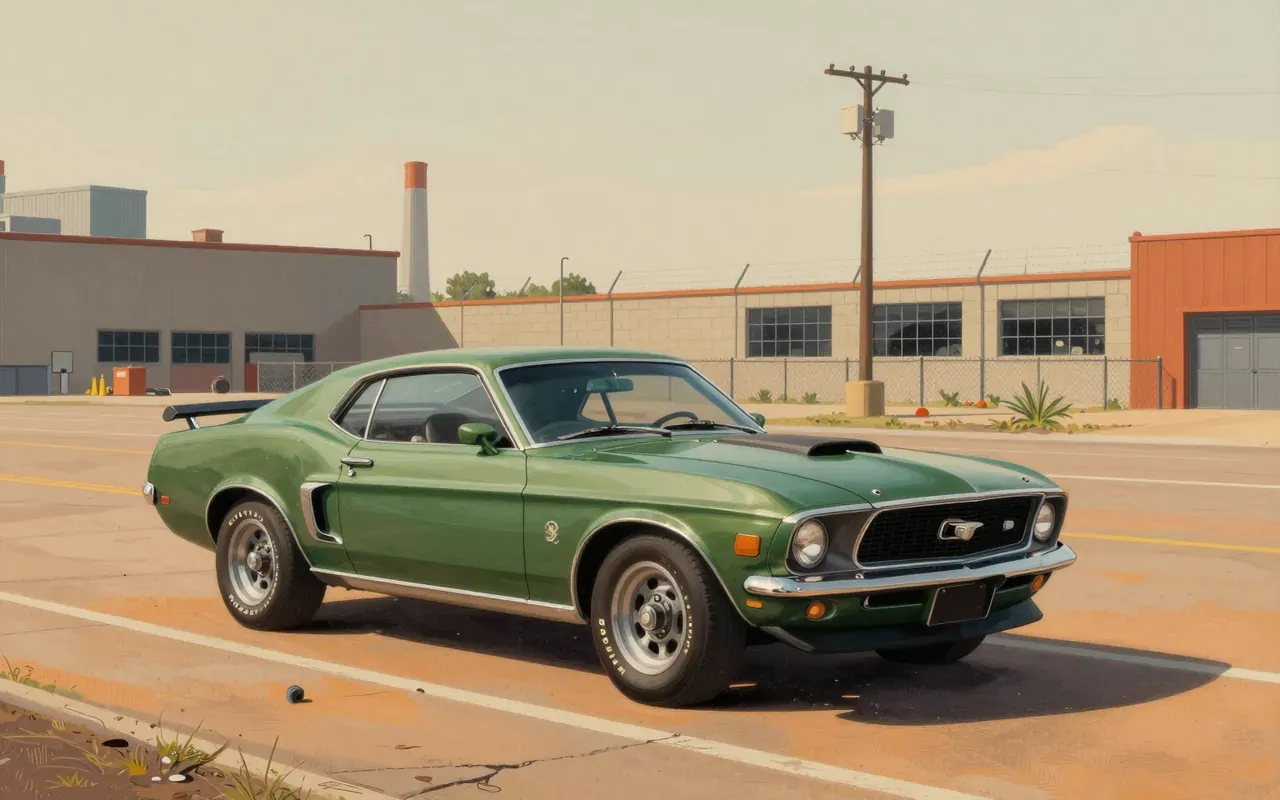
What the car is and where it came from
A 1969–1970 Ford Mustang fastback built to homologate a semi-hemispherical 429 cu in V8 for NASCAR. It is not a variant of the Boss 302; it is a separate, wider, heavier, more expensive machine engineered around one engine.
How it works, in terms someone would actually use
It places a race-derived semi-hemispherical 429 cu in V8 into a Mustang fastback. The engine’s width forced Kar Kraft to modify the front end extensively. It is a front-engine, rear-wheel-drive saloon built for NASCAR homologation, not daily usability.
What it gets right
It gets homologation right: 1,359 units exceeded NASCAR’s 500-car requirement. It gets purpose right: every modification serves the engine’s fit and function. It gets naming right: ‘Boss’ signals authority—not aspiration.
What it does not
It does not offer accessible performance. It does not fit standard Mustang service routines. It does not prioritise driver feedback over engine installation. It does not scale down cost or complexity for buyers.
What it changed
It proved that NASCAR’s 500-car homologation rule could force manufacturers to build radically re-engineered street cars. It shifted Ford’s performance hierarchy: the Boss 302 was agile; the Boss 429 was brute-force validation.
Who it is for, and who it is not
It is for collectors who value homologation logic over drivability. It is for engineers studying forced packaging compromises. It is not for restorers seeking common parts. It is not for drivers seeking refinement or affordability.
Is it worth your time
Yes—if you need to understand how homologation drives extreme mechanical compromise in production cars. No—if you are looking for a usable, balanced, or affordable classic Mustang.