automotivebriefs
9:48in productionCh. 1 · Homologation First/ 9:48 · ceiling 15 min
Racing · Supercars

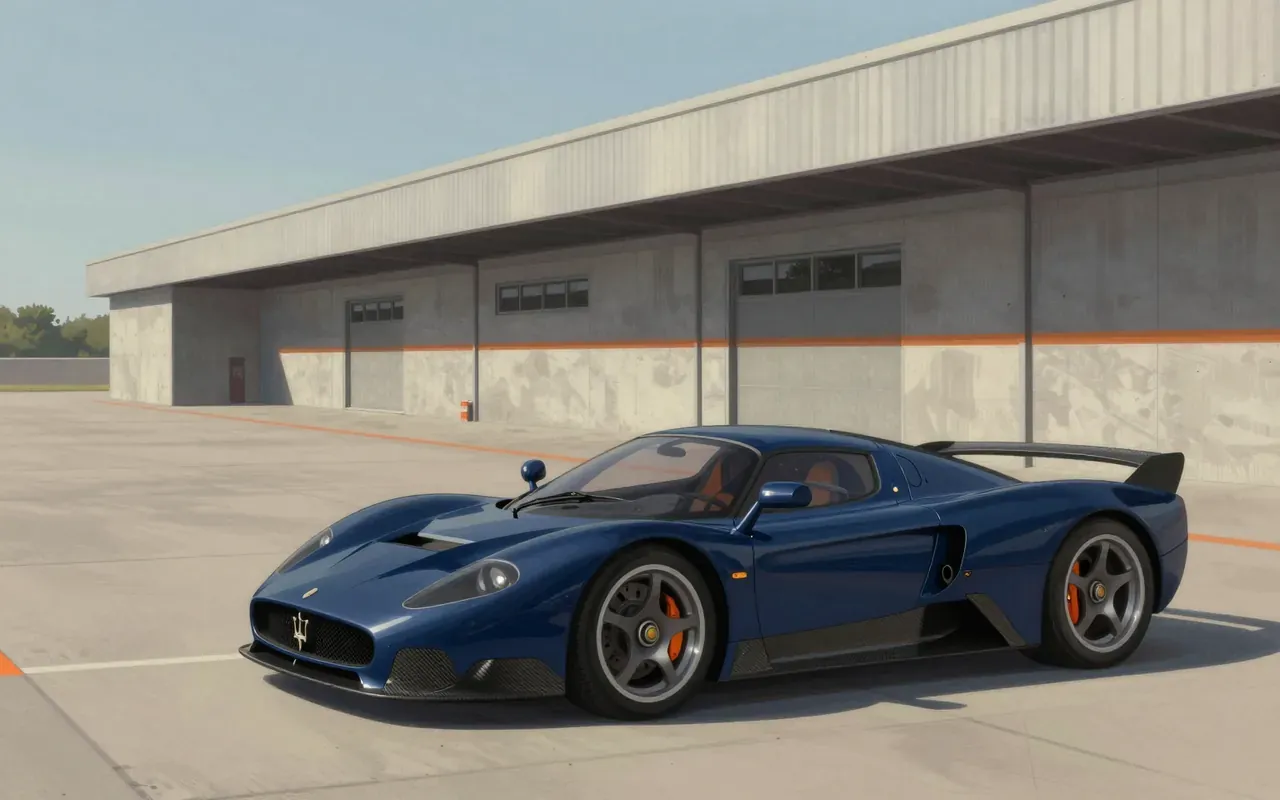
Maserati MC12

A race car disguised as a road car — and the disguise is the point.

The Maserati MC12 is a homologation special built to return Maserati to FIA GT racing. Designed by Frank Stephenson on the Ferrari Enzo’s chassis, it is longer, wider, taller, and more aerodynamically efficient. Its mid-rear V12 layout prioritises balance over packaging. Only 62 were built: 50 road cars and 12 racers. It is uncompromising, specific, and historically consequential — but not versatile.

Chapters & takeaways4
  1. 1:08
    Homologation First

    The MC12 exists only because the FIA demanded 25 road cars to run a racer.

  2. 2:48
    Enzo Expanded

    It is larger and more aerodynamically refined than the Enzo, with its engine placed for optimal weight distribution.

  3. 4:13
    Stephenson’s Shape

    Frank Stephenson led the styling as Director of Ferrari-Maserati Concept Design and Development, building on Giugiaro’s initial idea.

  4. 6:08
    Fifty Plus Twelve

    Just 62 were made: 50 road cars (in two batches) and 12 racers; the targa roof detaches but has no in-car storage.

Worth your time?

Yes. Drive the whole thing.

4.5/ 5
What works
  • homologation logic
  • weight distribution
  • aerodynamic enlargement
What does not
  • daily usability
  • practicality
  • regulatory flexibility outside Europe
Drive it if
  • collectors
  • GT racing historians
  • aerodynamic design students
Skip it if
  • commuters
  • families
  • track-day beginners
The written brief1 min read

What the car is and where it came from

The MC12 is a limited-production, mid-rear-engined, two-door coupé styled primarily by Frank Stephenson under Giorgio Ascanelli’s direction. It was built from 2004 to 2005 on the Ferrari Enzo’s chassis, enlarged for aerodynamics and FIA GT homologation.

How it works, in terms someone would actually use

The MC12 is a mid-rear-engined two-door coupé with a targa top roof. Its engine sits longitudinally behind the cabin but between the axles. The detached roof cannot be stored in the car.

What it gets right

It gets right the translation of wind-tunnel logic into body language: longer, wider, taller than the Enzo, with a sharper nose and smoother curves to achieve a lower drag coefficient. It places the centre of gravity mid-axle for stability and cornering response.

What it does not

It does not offer driver-adjustable suspension, variable valve timing, or any interior storage for the targa panel. It does not accommodate more than two people or luggage beyond minimal essentials.

What it changed

It re-established Maserati in international GT racing after 37 years. It proved that a road car built solely to satisfy FIA GT’s 25-unit homologation rule could define a brand’s return to competition.

Who it is for, and who it is not

It is for collectors who value purpose-built engineering over daily usability. It is not for anyone needing practicality, adaptability, or regulatory compliance outside Europe.

Is it worth your time

Yes — if you care about how homologation shapes form, or how a racing mandate forces radical aerodynamic enlargement of an existing chassis.
Same garage · Racing4 of 33
10:28
Chevrolet Corvette (C5)John Cafaro · 1997The Chevrolet Corvette (C5) is the fifth-generation Corvette sports car, produced from 1997 to 2004. It introduced a hydroformed box frame, rear-mounted transaxle, and the all-aluminium LS1 engine — the first GM vehicle with third-generation LS engines. It was the last Corvette with pop-up headlights. The Z06 variant launched in 2001. The C5-R racing variant won the 24 Hours of Daytona and 24 Hours of Le Mans in the GTS/GT1 class.
8:30
Ferrari F50Lorenzo Ramaciotti · 1995The Ferrari F50 is a 1995–1997 limited-run targa-top supercar. Its 4.7 L V12 came from Formula One. Its shape grew from the 1989 Mythos concept and borrowed F1 front-end cues. It uses a rear mid-engine, rear-wheel-drive layout. Only 349 were built.
10:42
Boss 429 MustangLarry Shinoda · 1969The Boss 429 Mustang is a 1969–1970 homologation special built solely to qualify Ford’s semi-hemispherical 429 cu in V8 for NASCAR. Its engine was too wide for the Mustang’s engine bay—requiring Kar Kraft to widen the front end. Priced at nearly $5,000 and limited to 1,359 units, it sacrificed usability, cost, and serviceability for one purpose: counting toward NASCAR’s 500-car rule. Larry Shinoda, who named the Boss line as a homage to Bunkie Knudsen, did not design this car—but its existence follows directly from the logic he established with the Boss 302.
8:32
Lotus ExigeRussell Carr · 2000The Lotus Exige is a British sports car produced from 2000 to 2021. It began as a hardtop coupé derivative of the Elise roadster. Its name means 'demand' or 'require' in French. The original 2000 model used a naturally aspirated 1.8 L Rover K-Series inline-four. Series 2 (2004) switched to a naturally aspirated 1.8 L Toyota/Yamaha 2ZZ-GE. Series 3 (2012) adopted a supercharged 3.5 L V6 from the Evora S. All generations featured mid-engine, rear-wheel-drive layout, non-removable hardtop, kamm-tail rear bodywork, and a pylon-mounted rear wing.
Up next in Automotive

Matra 530

Philippe Guédon · 1967 · 9:35

A French missile named a car that redefined where the engine went—and why it mattered.

9:35