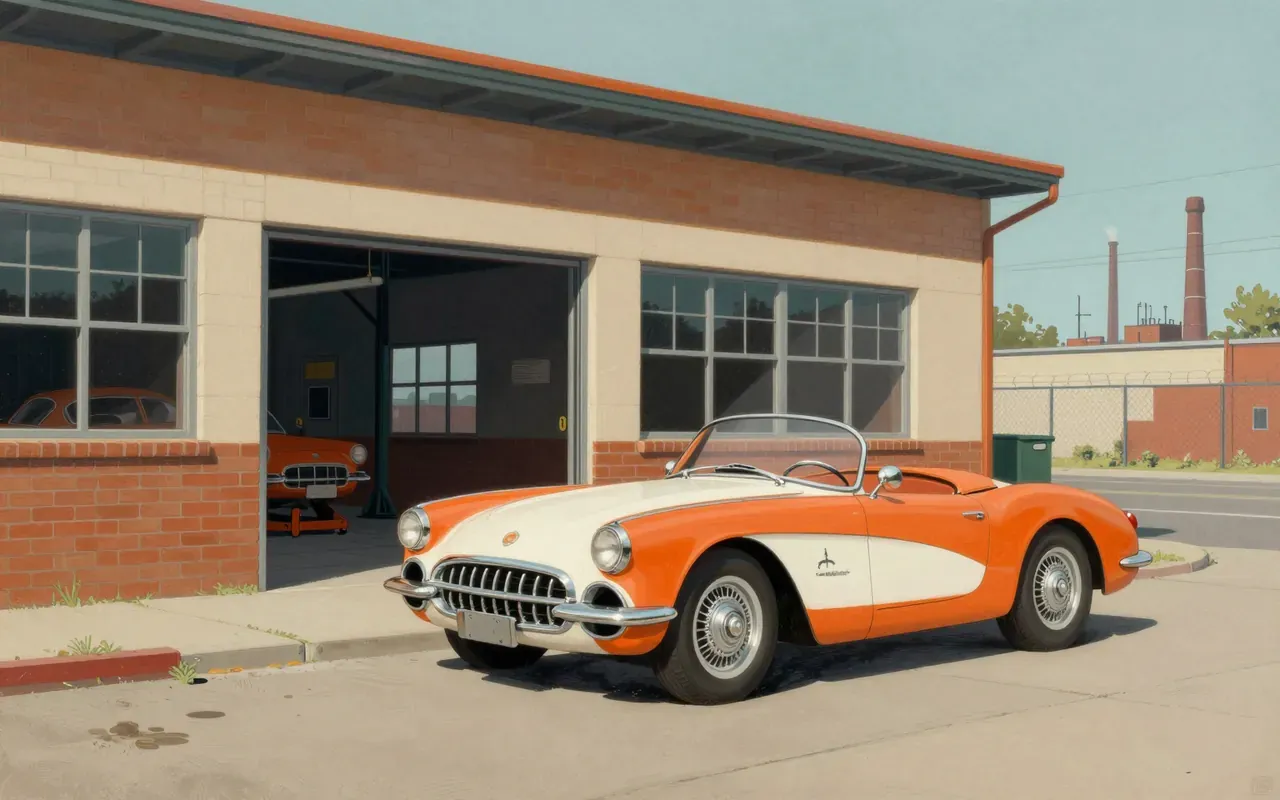
America’s first postwar sports car was a styling exercise masquerading as engineering—brilliantly flawed, deliberately incomplete.
The C1 Corvette is the foundational American sports car: a rushed, hand-built, fibreglass roadster born from Harley Earl’s desire to answer European competition. It established Chevrolet’s two-seat lineage after 15 years’ silence. Its front-engine, rear-wheel-drive layout and solid rear axle reflect its derivation from full-size Chevrolets—not racing pedigree. It prioritises presence over precision. It is historically indispensable but dynamically unrefined.
Harley Earl launched the Corvette to counter English and European sports cars—not to match them.
2:24
The First 300 Were Prototypes Sold as Production
Rushed into production in 1953, it was less a finished car than a public test of the idea.
4:03
Built on Old Bones, Claiming New Ground
Its solid rear axle and lack of two-seat convertibles since 1938 made it both archaic and revolutionary.
5:16
Code-Named for a Division That Didn’t Build It
'Project Opel' was secret not for espionage—but because GM didn’t believe in it yet.
6:41
A Handoff That Rewrote Chevrolet’s Identity
Assigned to Chevrolet on a whim, it became the brand’s first two-seat roadster in 15 years.
8:06
Driven by a Fan, Not a Focus Group
Earl’s personal passion for sports cars overrode corporate caution—and defined the car’s direction.
Worth your time?
Yes. Drive the whole thing.
3.5/ 5
What works
commits to two seats and roadster body after 15-year gap
establishes visual language of postwar American sports car
forces GM to build dedicated sports car identity
What does not
deliver balanced handling
disguise its sedan-derived chassis
offer independent rear suspension
Drive it if
people who care about origin stories
those studying stylistic intent
students of industrial pivot points
Skip it if
those seeking driving refinement
those requiring engineering cohesion
those expecting performance credibility
The written brief1 min read
What the car is and where it came from
The first-generation Chevrolet Corvette (C1). A hand-built 1953 roadster conceived by Harley Earl as GM’s answer to English and European sports cars. Developed secretly as ‘Project Opel’ from late 1951. Introduced late in the 1953 model year.
How it works, in terms someone would actually use
Front-engine, rear-wheel-drive layout. Solid rear axle. Fibreglass body mounted on a chassis derived from Chevrolet’s full-size cars. Two-seat roadster configuration.
What it gets right
It gets right the visual language of a postwar American sports car: low, long, open, and urgent. It commits to two seats and a roadster body when Chevrolet had offered none since 1938.
What it does not
It does not offer independent rear suspension. It does not deliver balanced handling or high-performance dynamics. It does not disguise its origins in a family sedan platform.
What it changed
It established Chevrolet as a maker of two-seat roadsters after a 15-year gap and forced GM to build a dedicated sports car identity from scratch.
Who it is for, and who it is not
It is for people who care about origin stories, stylistic intent, and industrial pivot points. It is not for those seeking driving refinement, engineering cohesion, or performance credibility.
Is it worth your time
Yes—if you want to understand how American mass-market ambition collided with European sports car ideals in raw, unrefined form.