automotivebriefs
11:12in productionCh. 1 · Name vs. reality/ 11:12 · ceiling 15 min
Saloons & estates

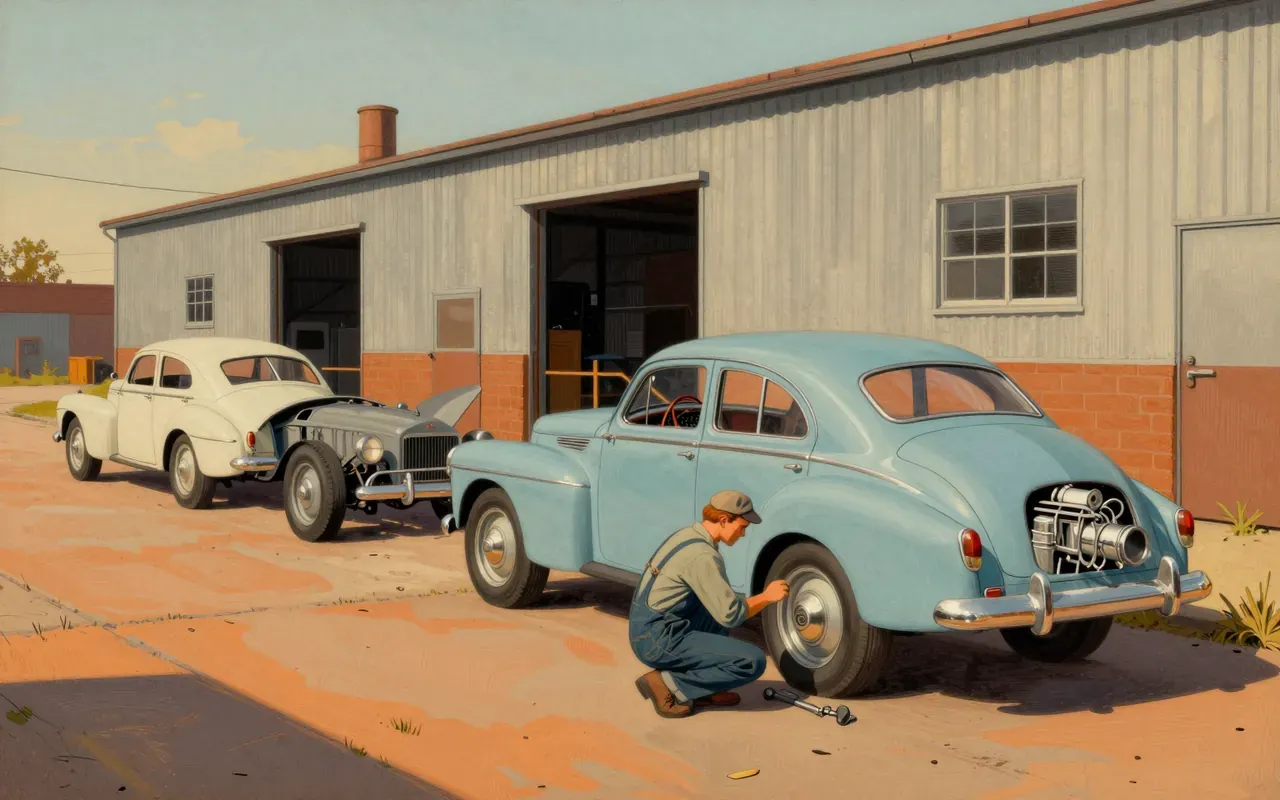
Tucker 48

A sedan built to sell a vision—not a vehicle.

The Tucker 48 is a saloon defined by unmet promise and tangible innovation. It established safety and driver-centred layout as non-negotiables—before Detroit accepted them. It failed to deliver its own engine or prove its systems in volume. Its legacy is procedural, not mechanical.

Chapters & takeaways6
  1. 1:15
    Name vs. reality

    The Torpedo was a prototype; the production car was the Tucker 48.

  2. 2:29
    What it drove

    Rear-engine, RWD layout—but powered by a converted helicopter engine, not the promised flat-6.

  3. 3:33
    What it delivered

    It specified seat belts, padded dash, disc brakes—and delivered a third headlamp that turned with the wheels.

  4. 5:13
    The gap between claim and build

    Promised '15 years of testing' before any running prototype existed—and folded after 51 cars.

  5. 6:32
    Who drew the line

    Alex Tremulis designed the sedan and guided the 'Tin Goose' prototype to completion.

  6. 7:47
    Where it lived—and died

    Conceived in Ypsilanti. Built in Chicago. Dead by March 1949.

Worth your time?

Yes. Drive the whole thing.

3.5/ 5
What works
  • central directional headlamp
  • padded dashboard
  • seat belts as standard
  • instrument placement within reach
What does not
  • deliver flat-6 engine
  • prove disc brakes at scale
  • validate fuel injection in production
  • survive beyond 1949
Drive it if
  • students of regulation
  • design historians
  • policy analysts
Skip it if
  • drivers
  • collectors seeking usability
  • engineers seeking benchmark data
The written brief1 min read

What the car is and where it came from

The Tucker 48 is a 1948 American sedan conceived by Preston Tucker in Ypsilanti, Michigan, and built in Chicago, Illinois. Alex Tremulis designed it. Fifty-one units—including prototype—were made before operations ceased on March 3, 1949.

How it works, in terms someone would actually use

The driver sits in a sedan body with all instruments within reach of the steering wheel. The rear-mounted engine drives the rear wheels. A third headlamp turns with the front wheels when steering beyond 10 degrees.

What it gets right

It places the driver at the centre of the cabin layout. It integrates seat belts and a padded dashboard as standard. It solves visibility in corners with a mechanically linked directional lamp.

What it does not

It does not deliver on its claimed flat-6 engine: the first production cars used a converted Franklin helicopter engine. It does not prove disc brakes, fuel injection or independent suspension worked at scale—only that they were specified and prototyped.

What it changed

It forced public and regulatory scrutiny of automotive innovation claims before first drive. It showed that radical packaging could coexist with safety features no other US sedan offered in 1948.

Who it is for, and who it is not

It is for students of industrial policy, automotive regulation and mid-century American mythmaking. It is not for drivers seeking reliability, parts availability or verified performance.

Is it worth your time

Yes—if you care about how ambition, regulation and industrial design collide in real time. No—if you need a working car, proven engineering or production continuity.
Same garage · Saloons & estates4 of 60
9:19
Lucid AirDerek Jenkins · 2021The Lucid Air is a battery electric four-door luxury sedan, Lucid Motors' first production car, announced in December 2016 and launched in 2021. It highlights its record-setting EPA range (up to 520 miles for the Dream Edition), aerodynamic efficiency (Cd=0.21 pre-production, Cd=0.20 production), performance capabilities (e.g., 0–60 mph in 2.5 seconds, 235 mph top speed), and technical features including its 924-volt architecture, bidirectional charging, and DreamDrive ADAS with 32 sensors. The Air Pure, Touring, Grand Touring, and Dream Edition trims are detailed, along with battery capacities (88–112 kWh), power outputs (430–1,111 hp), and production milestones including commencement in late 2021 and deliveries beginning October 30, 2021. Design leadership is attributed to Derek Jenkins, and the vehicle is positioned against the Tesla Model S and German luxury models.
9:14
Mitsubishi Galant VR-4Mitsubishi · 1987The Galant VR-4 is Mitsubishi’s first high-performance all-wheel-drive sedan, developed for Group A rallying and launched in 1987. It introduced the Dynamic Four AWC system — a full-time four-wheel drive setup with viscous coupling, plus four-wheel steering and four-wheel ABS. It was sold globally to meet homologation requirements, including 2,000 units in the US in 1991 and 1,000 in 1992. Later generations added liftback (Eterna ZR-4) and station wagon (Legnum) variants. The eighth generation was initially JDM-only but gained overseas cult status via grey imports. In 2000, Ralliart officially imported 200 units to the UK. Production ended in 2002 due to revised Japanese emissions standards.
7:56
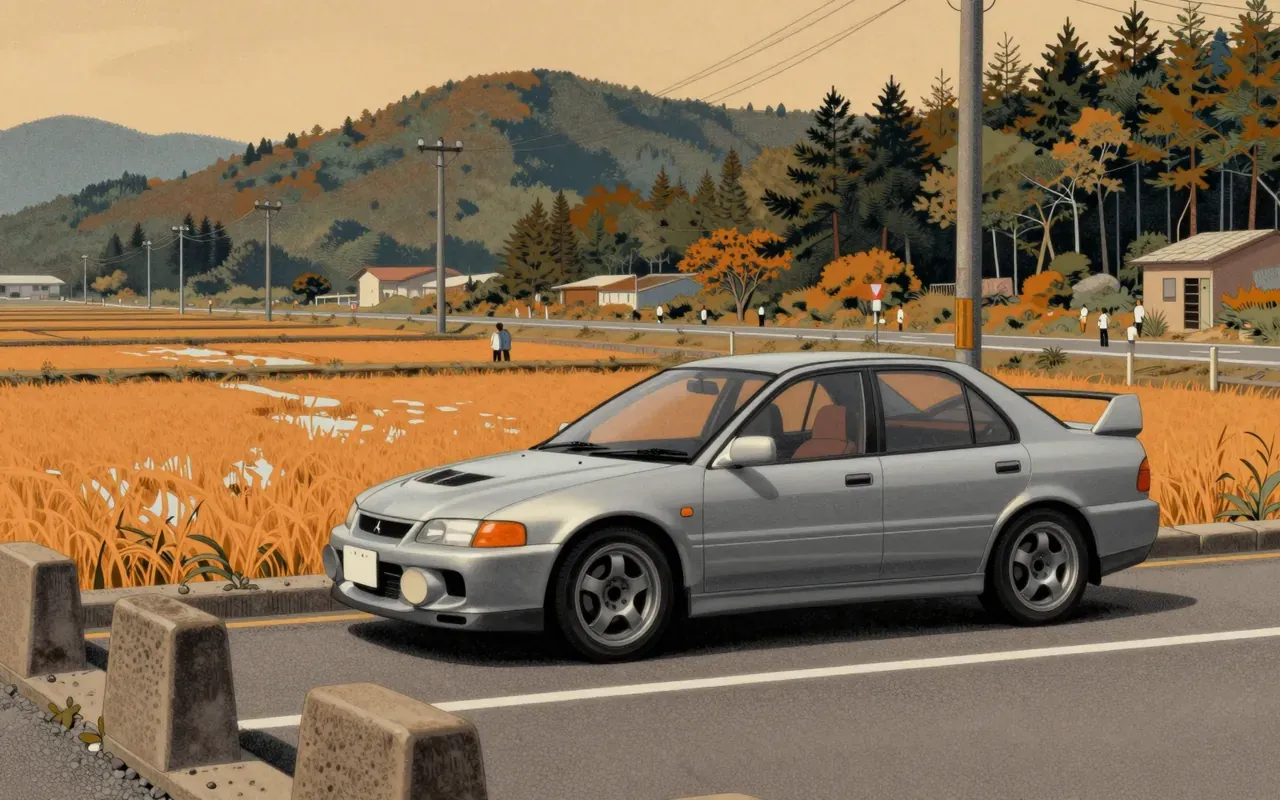
Mitsubishi Lancer EvolutionMitsubishi · 1999The Mitsubishi Lancer Evolution is a rally-bred sports sedan built on the Lancer platform. Ten generations were produced from 1992 to 2016. All used a two-litre intercooled turbo inline-four engine and all-wheel drive. It launched in Japan only, then reached the UK and Europe around 1997 via Ralliart dealers—starting with the Evolution IV.
10:45
Proton SagaMitsubishi · 1985The Proton Saga is a foundational Malaysian car—not a technical benchmark, but a political and industrial one.
Up next in Automotive

Vector W8

Gerald Wiegert · 1989 · 9:56

America’s first federally certified supercar—and its most uncompromising statement of intent.

9:56