What the car is and where it came from
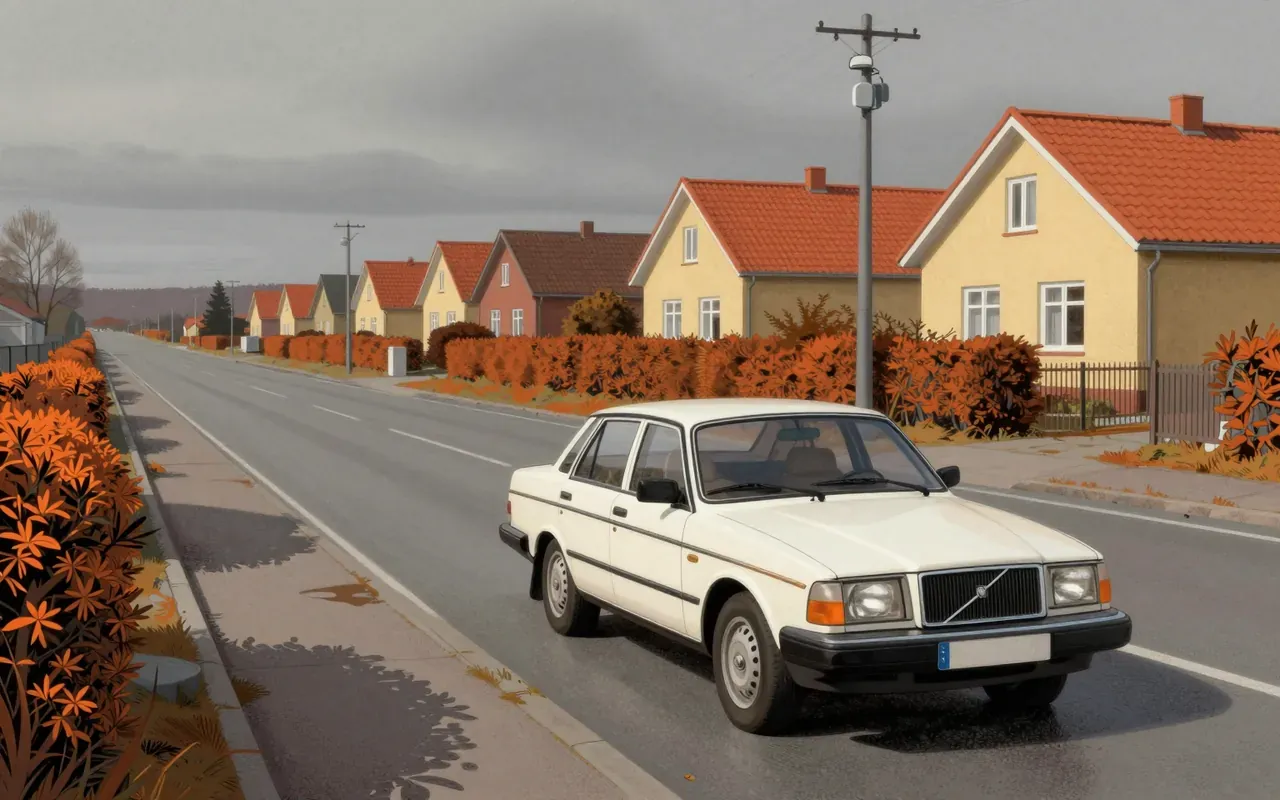
The 240 was one of two models in the Volvo 200 Series, the mid-size range Volvo built from 1974 to 1993. The series was designed by Jan Wilsgaard and developed from the 140 Series. It was introduced in autumn 1974 with six 240 variants and two 260 variants. The 240 came as a saloon with two or four doors, or as an estate.
How it works, in terms someone would actually use
Behind the cowl the 240 was almost identical to the 140. Ahead of it, the car was restyled with a “shovel nose” that resembled the VESC safety prototype of 1972, and it gained very large front and rear crumple zones. The front suspension was MacPherson strut, which freed room around the engine bay, and steering became rack-and-pinion. There were disc brakes at all four wheels.
Most 240s used Volvo’s red-block fours of 2.0 to 2.3 litres, with overhead-valve and overhead-cam versions. Later models added V6 engines in the GLE and GLT, the first turbocharged Volvo engine in 1981, and diesels bought from Volkswagen, including a six-cylinder 240 GL D6 from 1979.
What it gets right
It put safety into the structure. About a third of 240s sold were estates, with 41 cubic feet of cargo space and an optional rear-facing jumpseat with three-point belts, which made the estate a seven-seater. The floor was reinforced to protect those seated there.
Volvo kept improving it. An oxygen sensor, which Volvo called Lambda Sond, came to North America with the 1977 models. In late 1991 the 1992 car received 160 detail improvements, and a driver airbag arrived in the US from 1990.
What it does not
Early cars had severe rust problems, and 1978 models were the first with a new paint formula meant to solve them. The B28 V6 engines, introduced in 1980, were prone to top-end oiling troubles and early camshaft wear.
Its safety design also aged. Ingvar Kamprad, founder of IKEA, drove a 1993 240 DL until he was told it was too dangerous because of its outdated safety design, two decades later.
What it changed
The series established Volvo’s reputation for safety and durability, and many examples were still in service decades after production ended. Over 2.8 million 200 Series cars were built in 19 years. Volvo had planned to drop the 200 since the early 1980s, but it kept selling well and Volvo kept updating it.
Who it is for, and who it is not
It is for readers who want to see how a safety-first Volvo was built in the 1970s and 1980s, and for anyone drawn to the estate. It is not for those who want a modern crash-safety standard, or the full story of the 260, the Bertone coupe and the other special models.
Is it worth your time
Yes. The 240 outlived the 260, the 700 Series overlapped it from 1982, and the last regular car was built on 14 May 1993. It shows what a steady run of small updates can do to one body.