
automotivebriefs
10:00in productionCh. 1 · Designed for one race/ 10:00 · ceiling 15 min
Endurance

Toyota GT-One

A Le Mans weapon disguised as a grand tourer — and undone by the very rules it was built to beat.

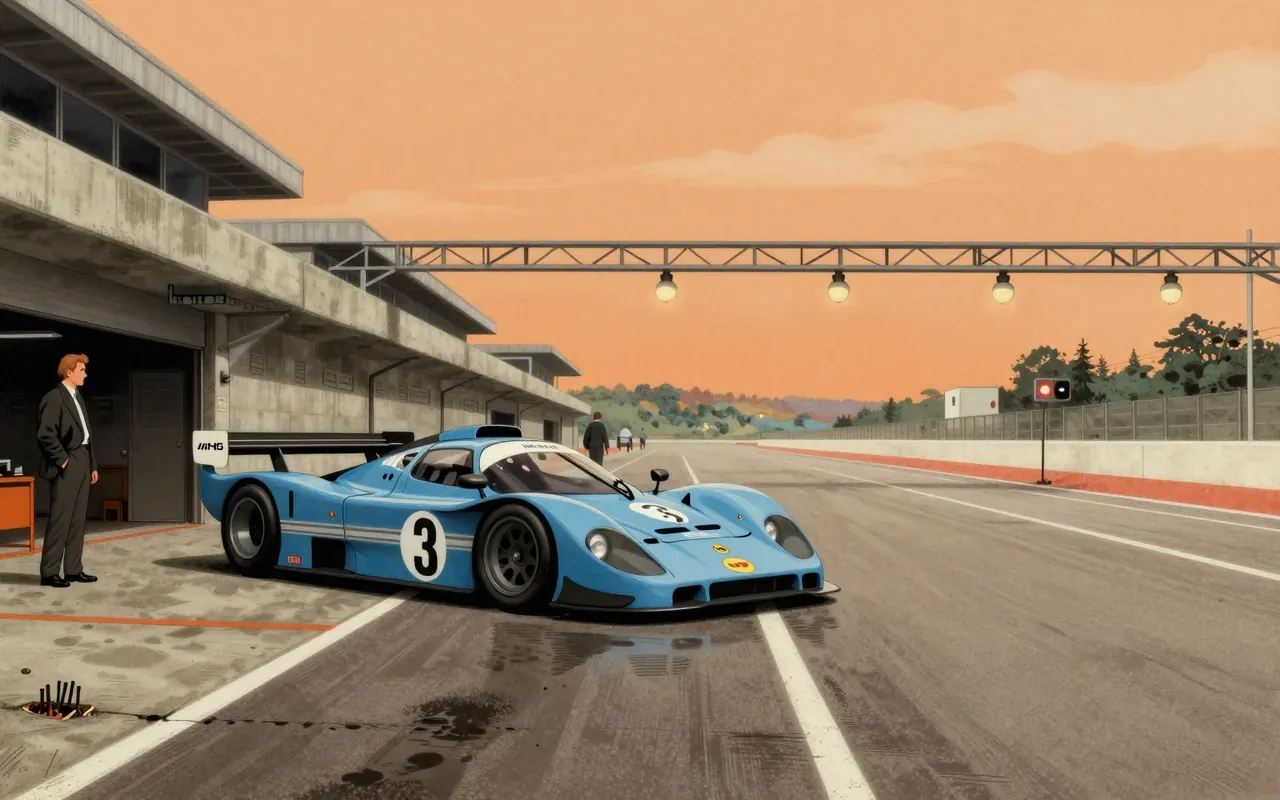
The Toyota GT-One (TS020) is a Le Mans-specific racing car designed by André de Cortanze for Toyota Team Europe. It ran under Group GT1 and later LMGTP regulations in 1998 and 1999. Seven chassis were built. Two road-legal versions satisfied homologation. Its twin-turbo 3.6 L R36V V8 was derived from Toyota’s Group C programme. Only two cars finished Le Mans — LM804 in 1999 and LM805 in 1998. The programme ended after 1999.

Chapters & takeaways4
  1. 1:00
    Designed for one race

    André de Cortanze designed the TS020 specifically for Le Mans — not as a concept, not as a road car, but as a race machine from the outset.

  2. 2:53
    Rules first, reliability second

    It started as a Group GT1 car, then became an LMGTP — a regulatory pivot that compromised durability without gaining outright speed.

  3. 4:28
    Engine heritage, paper legality

    Its twin-turbo V8 came from Toyota’s Group C lineage; its two road cars existed only to satisfy homologation — no more, no less.

  4. 5:50
    Seven built, two finished

    Seven chassis built. Two finished Le Mans. One — LM804 — raced both years. That is the full operational record.

Worth your time?

Yes. Drive the whole thing.

3.5/ 5
What works
  • aerodynamic efficiency
  • structural rigidity for high-speed Le Mans circuits
  • integration of upgraded Group C-derived engine into new carbon monocoque
What does not
  • deliver reliability at Le Mans distance
  • meet homologation with more than two road-legal versions
  • win outright
Drive it if
  • endurance-racing historians
  • regulation nerds
  • designers studying late-1990s prototype transitions
Skip it if
  • collectors
  • road drivers
  • fans of production-based GT cars
The written brief1 min read

What the car is and where it came from

The Toyota GT-One (TS020) is a purpose-built Le Mans racing car designed by André de Cortanze for Toyota Team Europe. It was developed for Group GT1, then adapted to LMGTP. Seven chassis were built between 1998 and 1999.

How it works, in terms someone would actually use

It is a carbon fibre LMGTP racing car built for the 24 Hours of Le Mans. It uses a twin-turbocharged 3.6 L R36V V8 engine. Its chassis and bodywork were designed and manufactured in-house by Toyota Team Europe.

What it gets right

It gets right the aerodynamic efficiency and structural rigidity needed for high-speed Le Mans circuits. It gets right the integration of an upgraded Group C-derived engine into a new carbon monocoque.

What it does not

It does not deliver reliability at Le Mans distance. It does not meet homologation with more than two road-legal versions. It does not win outright — its best result is second overall in 1999.

What it changed

It confirmed the fragility of Group GT1’s evolution into LMGTP: a rule set stretched too far, too fast. It did not change Toyota’s motorsport direction — TTE shifted to Formula One after 1999.

Who it is for, and who it is not

It is for endurance-racing historians, regulation nerds, and designers studying late-1990s prototype transitions. It is not for collectors, road drivers, or fans of production-based GT cars.

Is it worth your time

Yes — as a focused, late-1990s endurance prototype that exposed the limits of GT-based regulation adaptation. It is not worth your time if you seek production relevance, longevity or technical legacy beyond its two-year campaign.

Same garage · Endurance4 of 16
9:11
Chevrolet Corvette (C4)Jerry Palmer · 1984The C4 redefined the Corvette as a structurally coherent, driver-focused machine—not through power, but through chassis discipline. Its legacy rests on endurance records, not lap times. Its sole 1983 survivor is a museum artifact, not a driver’s car. It is the first Corvette that feels engineered, not assembled.
9:17
Mercedes-Benz CLK LMAMG · 1998The Mercedes-Benz CLK LM is a 1998 Group GT1 racing car built by Mercedes-Benz and AMG to win the FIA GT Championship. It uses a naturally aspirated M119 V8 with a flat-plane crankshaft, replacing the CLK GTR’s V12. Two road-legal CLK LM Straßenversion chassis were built for homologation — one destroyed in crash testing. It won every 1998 FIA GT race but retired from the non-championship 1998 24 Hours of Le Mans. Five chassis were built in total: three race, two road-legal. Mercedes ended its GT1 programme after 1998 when the FIA removed the GT1 class.
10:06
Peugeot 905Gérard Welter · 1990The Peugeot 905 is a sports-prototype racing car built by Peugeot Talbot Sport. It was developed for the 1991 World Sportscar Championship’s F1-inspired regulations. It debuted in the final two races of the 1990 season. It won nine of 17 races, including Le Mans in 1992 and 1993 (905B), and secured both driver’s and team’s titles in the 1992 championship. It features a carbon-fibre monocoque and a 3499 cc naturally aspirated V10. It has no documented connection to Gérard Welter’s Welter Racing.
9:18
Peugeot 9X8Matthias Hossann · 2022The Peugeot 9X8 is a Le Mans Hypercar-class sports prototype developed by Peugeot for the FIA World Endurance Championship. It marks their return to top-tier endurance racing after 11 years. It features a hybrid powertrain combining a twin-turbo 2.6-litre V6 engine with a front-axle electric motor. It was initially notable for its wingless aerodynamic design exploiting Hypercar regulation freedoms—though this concept was later revised with a rear wing and asymmetric tyre widths to improve competitiveness. The car debuted at the 2022 6 Hours of Monza and achieved its first podium in 2023 at Monza, followed by further podiums in 2024 and 2025.
Up next in Automotive

Trabant 601

Werner Lang · 1964 · 10:01

A car designed for scarcity, not speed — and it succeeded exactly where it was meant to.

10:01