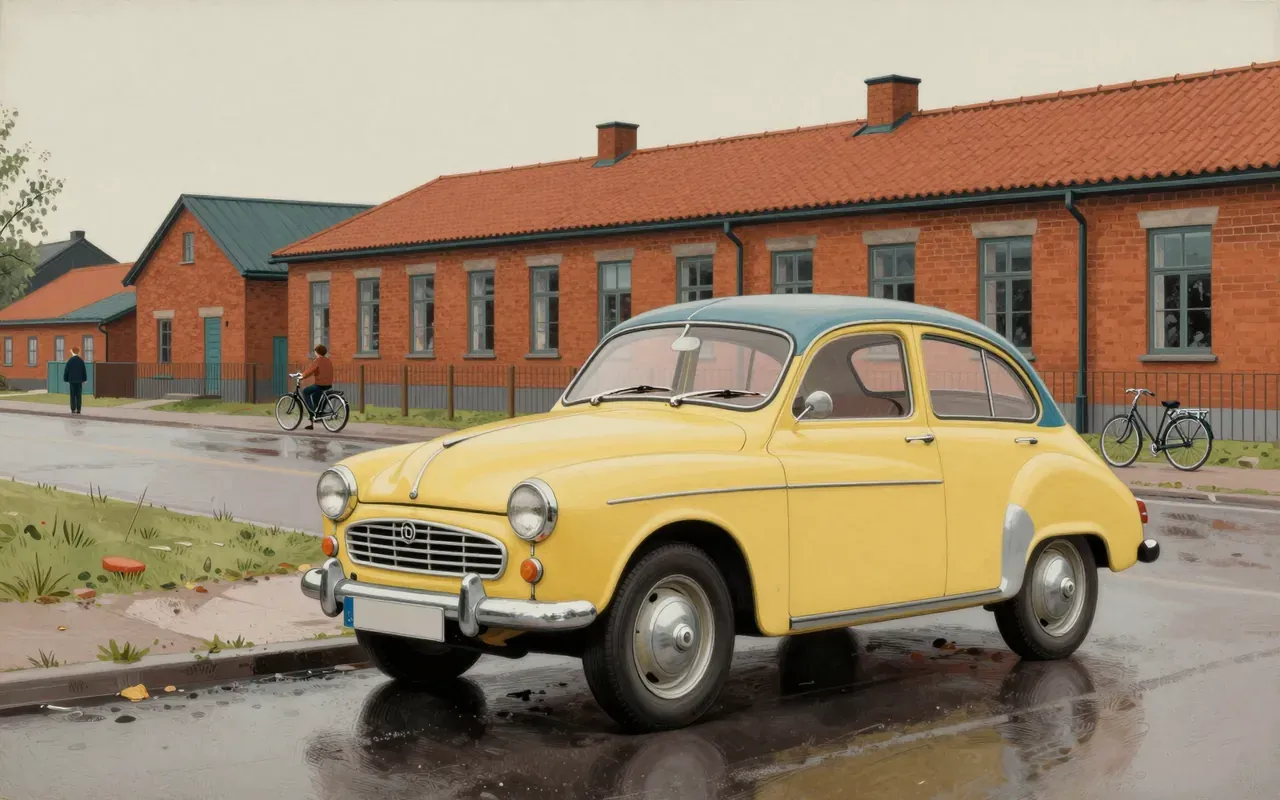
What the car is and where it came from
The Saab 92 is Saab’s first production car. It launched on 12 December 1949, derived from the Ursaab prototype. It is a front-wheel-drive saloon with a water-cooled, two-stroke, 764 cc engine.
How it works, in terms someone would actually use
The driver sits in a compact saloon with front-wheel drive and a transversely mounted two-cylinder two-stroke engine. Gear selection requires double-declutching into first, as it is unsynchronised. A freewheel engages automatically during overrun to protect the engine from oil starvation.
What it gets right
It gets aerodynamics right: a drag coefficient of 0.30 was exceptional for 1949. It gets structural simplicity right: the body is one stamped sheet-metal piece, cut only for doors and windows.
What it does not
It does not offer a standard version. It does not have synchronised first gear. It does not use a conventional chassis or multi-panel body construction.
What it changed
It proved front-wheel drive, transverse engines and low-drag packaging could work in mass production. It established Saab’s engineering identity before the brand had a market.
Who it is for, and who it is not
It is for engineers, industrial designers and students of automotive packaging. It is not for buyers seeking comfort, variety, or conventional powertrain behaviour.
Is it worth your time
Yes — if you care how aerodynamic logic, monocoque thinking and two-stroke pragmatism collided in postwar Sweden. No — if you expect refinement, choice or mechanical familiarity.