The W116 didn’t just launch the S-Class — it weaponised dignity against speed.
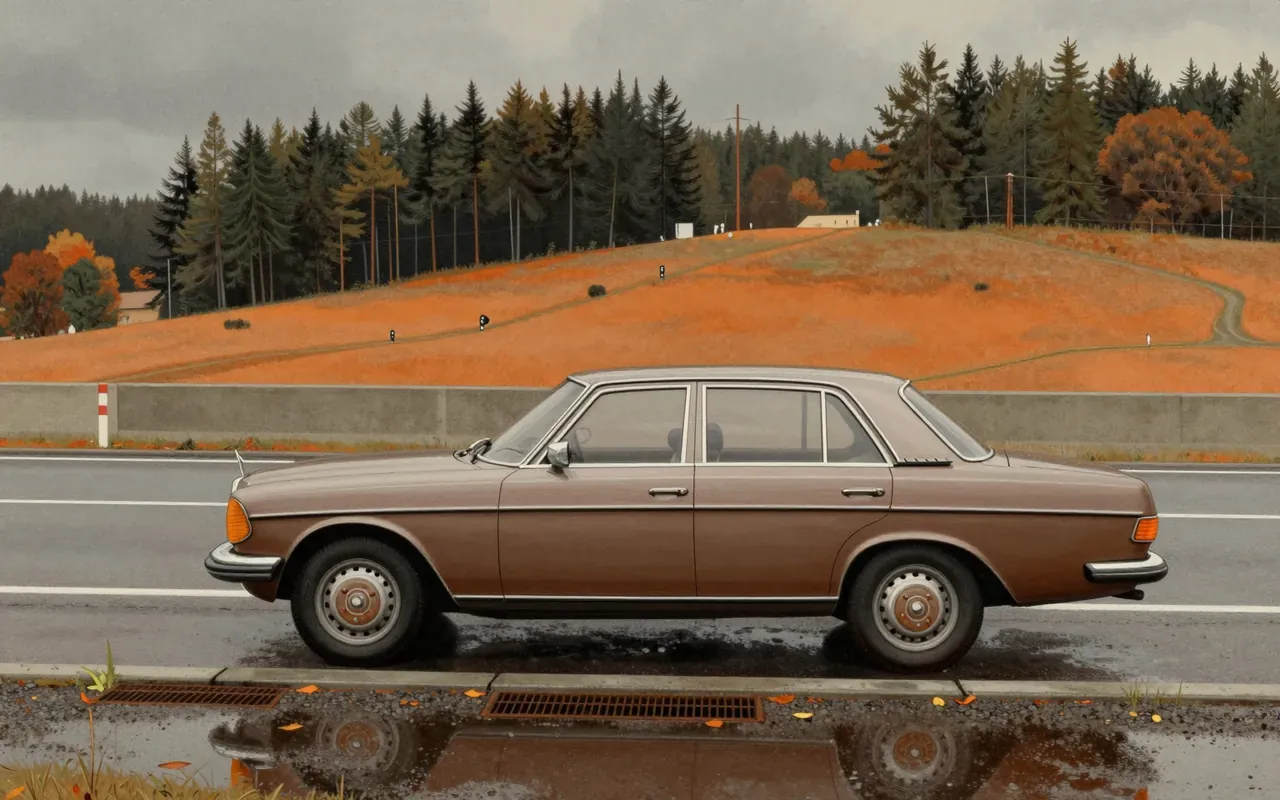
The W116 is the first official S-Class: a flagship luxury sedan built on a larger, separate platform, with independent suspension and four-wheel disc brakes. Designed by Friedrich Geiger and finalised in December 1969, it launched in 1972 and introduced Mercedes-Benz’s enduring corporate styling theme. It pioneered safety features including crumple zones and optional four-wheel anti-lock brakes. It won European Car of the Year in 1974. It established the S-Class as a benchmark for engineering integrity, not just opulence.
It is the first official S-Class — a deliberate break from informal nomenclature into corporate hierarchy.
2:17
The Line That Lasted Until 1997
Its 1969-finalised design introduced a corporate styling language that defined Mercedes-Benz for 25 years.
3:48
Engineering Built for Weight and Width
Independent suspension and four-wheel discs were standard — not optional — on a dedicated, larger platform.
4:48
The Only S-Class to Win ECOTY
It won European Car of the Year in 1974 — the only S-Class to do so.
Worth your time?
Yes. Drive the whole thing.
4.5/ 5
What works
It establishes authority through proportion, restraint, and structural integrity.
Its crumple zones and optional four-wheel anti-lock brakes were pioneering in 1972.
Its design conveys purpose without ornament.
What does not
It does not offer all-wheel drive.
It does not use a unibody structure shared with smaller models.
It does not feature electronic stability control or airbags.
Drive it if
It is for buyers who prioritise durability, passive safety, and understated presence over agility or driver engagement.
It is not for enthusiasts seeking light steering, tight packaging, or dynamic feedback.
Skip it if
It is not for enthusiasts seeking light steering, tight packaging, or dynamic feedback.
The written brief1 min read
What the car is and where it came from
The Mercedes-Benz W116 is a series of flagship luxury sedans produced from September 1972 until 1980. It was the first Mercedes-Benz model officially called S-Class. Friedrich Geiger designed it. Development began in 1966. The design was finalized in December 1969.
How it works, in terms someone would actually use
It is a rear-wheel-drive, four-door sedan with independent suspension and disc brakes on all four wheels. It uses a larger, separate platform from the W114/W115. Its layout places the engine longitudinally ahead of the front axle.
What it gets right
It establishes authority through proportion, restraint, and structural integrity. Its crumple zones and optional four-wheel anti-lock brakes were pioneering in 1972. Its design conveys purpose without ornament.
What it does not
It does not offer all-wheel drive. It does not use a unibody structure shared with smaller models. It does not feature electronic stability control or airbags — those came later.
What it changed
It introduced the official S-Class designation and launched Mercedes-Benz’s corporate styling theme, which lasted until 1997. It made crash safety and driver assistance features central to flagship sedan design.
Who it is for, and who it is not
It is for buyers who prioritise durability, passive safety, and understated presence over agility or driver engagement. It is not for enthusiasts seeking light steering, tight packaging, or dynamic feedback.
Is it worth your time
Yes. It redefined Mercedes-Benz’s identity and set safety and engineering benchmarks that shaped luxury sedans for decades.