automotivebriefs
9:45in productionCh. 1 · What It Is/ 9:45 · ceiling 15 min
Sports cars · Supercars

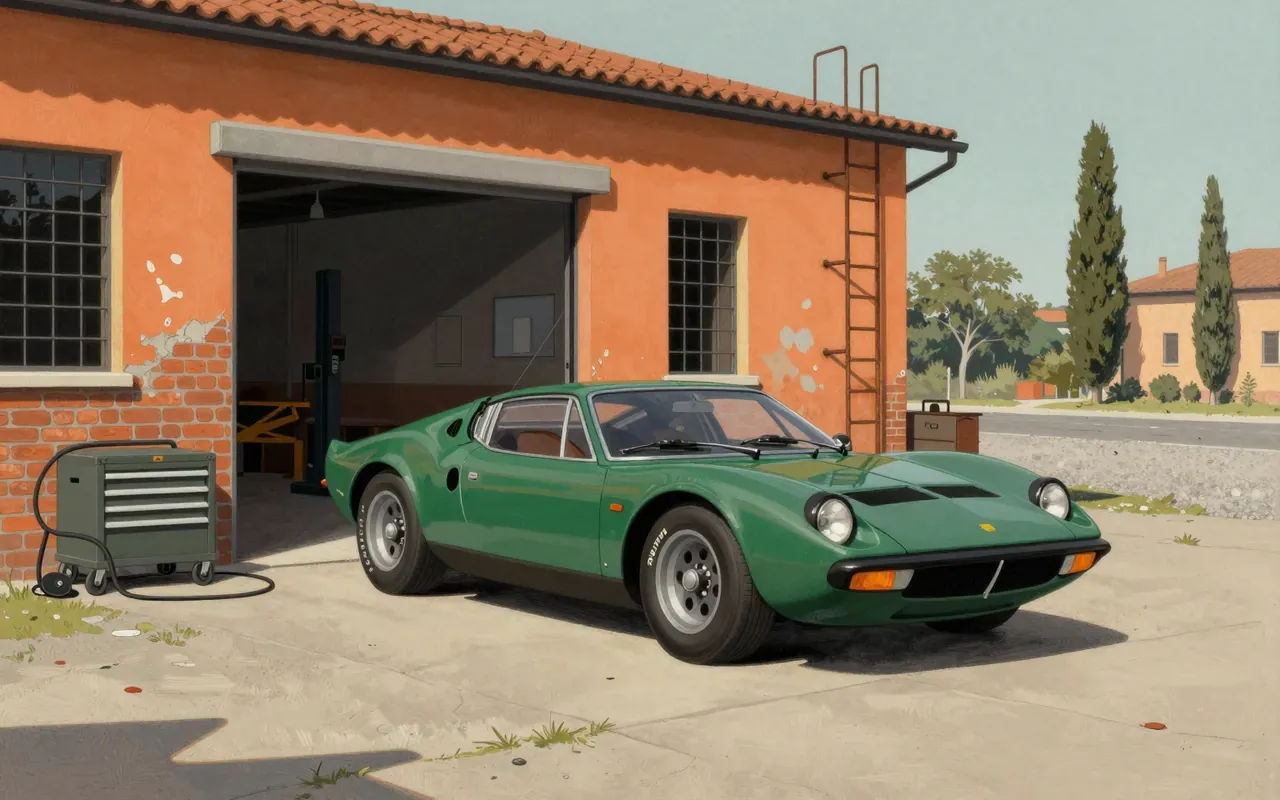
De Tomaso Pantera

An Italian sports car built to sell in American dealerships—not to win races or set lap times.

The De Tomaso Pantera is a mid-engine, rear-wheel-drive sports car designed by Tom Tjaarda at Ghia in 1970 and built by Italian manufacturer De Tomaso from 1971 to 1992. Its steel monocoque chassis was the brand’s first use of that construction. Over 7,000 units were produced—the most of any De Tomaso—with more than three quarters sold through Lincoln-Mercury dealers in the US between 1972 and 1975.

Chapters & takeaways4
  1. 0:52
    What It Is

    The Pantera was De Tomaso’s first mid-engine, steel monocoque sports car—and its longest-running model.

  2. 2:34
    Who Drew It

    Tom Tjaarda designed it in 1970 at Ghia—son of a Dutch designer who shaped the Lincoln Zephyr.

  3. 4:08
    How It’s Built

    Its steel monocoque was De Tomaso’s first use of that construction—replacing the Mangusta’s backbone chassis.

  4. 5:45
    How It Sold

    Over 7,000 were made—the most of any De Tomaso—with more than three quarters sold by Lincoln-Mercury dealers from 1972 to 1975.

Worth your time?

Yes. Drive the whole thing.

3.5/ 5
What works
  • The steel monocoque gave rigidity and safety over the older backbone chassis.
  • The Ghia styling—clean, low, purposeful—gave instant presence without ornament.
What does not
  • It does not isolate the driver from mechanical noise or heat.
  • It does not offer adjustable suspension, power steering, or modern crash structures.
Drive it if
  • It is for people who care about industrial alignment—how design, engineering, and distribution intersect.
  • It is not for those seeking driver aids, refinement, or documented performance figures.
Skip it if
  • It is not for those seeking driver aids, refinement, or documented performance figures.
The written brief1 min read

What the car is and where it came from

A mid-engine, rear-wheel-drive sports car designed by Tom Tjaarda at Ghia in 1970 and built by Italian manufacturer De Tomaso from 1971 to 1992.

How it works, in terms someone would actually use

It places the driver behind a large V8, mid-mounted in a steel monocoque chassis. The layout demands constant attention: weight sits low and central, but the engine is long and heavy, dictating packaging compromises.

What it gets right

The steel monocoque gave rigidity and safety over the older backbone chassis. The Ghia styling—clean, low, purposeful—gave instant presence without ornament.

What it does not

It does not isolate the driver from mechanical noise or heat. It does not offer adjustable suspension, power steering, or modern crash structures.

What it changed

It shifted De Tomaso from niche boutique to volume producer. It proved a mid-engine sports car could be built with mass-market Ford power and sold via Lincoln-Mercury showrooms.

Who it is for, and who it is not

It is for people who care about industrial alignment—how design, engineering, and distribution intersect. It is not for those seeking driver aids, refinement, or documented performance figures.

Is it worth your time

Yes—if you want to understand how an Italian sports car was made to sell through American dealerships, not just how it drove.
Same garage · Sports cars4 of 139
8:12
Alpine A110 (2017)Antony Villain · 2017The Alpine A110 (2017) is a rear mid-engine, rear-wheel-drive sports car built on an all-aluminium chassis and powered by a Nissan-derived 1.8-litre turbocharged inline-four engine. It debuted at the 2017 Geneva Motor Show. Production ended in June 2026.
8:32
Alpine A310Michel Beligond · 1971The Alpine A310 is a French sports car, launched in 1971 as Jean Rédélé’s final Alpine model. It debuted at the 1971 Geneva Motor Show. It used a tubular steel backbone chassis and a one-piece fiberglass body. Its engine was mounted longitudinally in the rear and drove the rear wheels via a five-speed manual gearbox. The driving position was low and sporty, with footwells angled toward the car’s centre.
9:14
Renault Alpine GTA/A610Heuliez · 1984The Renault Alpine GTA is a rear-engined sports coupé launched in 1985 by Alpine under full Renault ownership. It replaced the A310, sharing its layout and V6 PRV engine. Marketed as the Alpine V6 GT or V6 Turbo in Europe—and as the Renault GTA in Britain—it featured aerodynamic design (Cx 0.28–0.30), lightweight composite body panels, and a steel backbone chassis. Production spanned 1984–1995, totalling ~7,300 units across both GTA and A610 models.
9:40
BMW 8 Series (E31)Klaus Kapitza · 1989The BMW 8 Series (E31) is a two-door grand tourer built by BMW from 1990 to 1999. It uses a front-engine, rear-wheel-drive layout. It is powered by either a V8 or V12 engine. Development began in July 1981 and concluded in 1986. It debuted at the Frankfurt Motor Show in early September 1989. BMW used CAD tools to design its all-new body. Its drag coefficient is Cd=0.29. It replaced the E24 6 Series but was not a direct successor. Total production was 30,609 units.
Up next in Automotive

De Tomaso Vallelunga

Fissore · 1964 · 9:52

A mid-engine experiment so raw it had to be scrapped when no one wanted it.

9:52