automotivebriefs
8:35in productionCh. 1 · Not a Skyline/ 8:35 · ceiling 15 min
Sports cars · Supercars

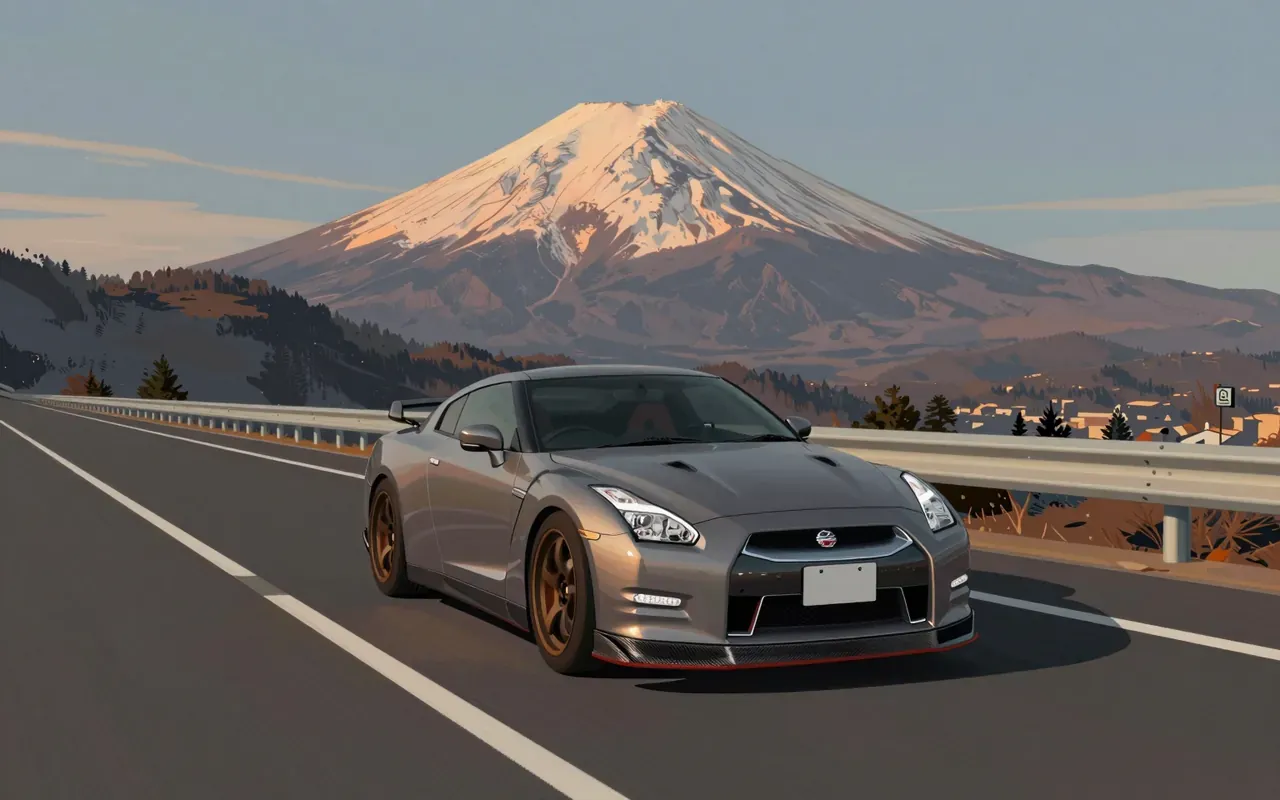
Nissan GT-R

A world-beating sports car built not to honour history — but to erase it.

The Nissan GT-R (R35) is a Japanese sports car and grand tourer produced from 2007 to 2025. It features a front-mid mounted 3.8 L V6 engine and all-wheel drive, built on the PM platform — a derivative of the FM platform — and was developed over seven years as part of the Nissan Revival Plan to deliver world-beating performance.

Chapters & takeaways5
  1. 0:48
    Not a Skyline

    The R35 is the sixth GT-R — but the first unmoored from the Skyline.

  2. 1:50
    Engineered for Grip

    Front-mid engine and all-wheel drive sit on the PM platform — a derivative of the FM architecture.

  3. 3:00
    Built to Beat the World

    Seven years of development, starting in 2000, aimed squarely at world-beating performance.

  4. 4:06
    Designed in Tokyo

    Shiro Nakamura shaped its form to fuse Japanese tradition with modern culture.

  5. 5:17
    Made in Tochigi

    A 2+2 grand tourer built on a shared line at Nissan’s Tochigi plant.

Worth your time?

Yes. Drive the whole thing.

4.5/ 5
What works
  • 2+2 grand touring layout
  • PM platform derived from FM architecture
  • front-mid engine placement
  • all-wheel drive system
What does not
  • rear-wheel drive
  • naturally aspirated engine
  • Skyline platform sharing
Drive it if
  • drivers who demand all-wheel-drive traction
  • those who want front-mid engine balance
  • people needing daily usability with performance intent
Skip it if
  • those seeking minimalist driver engagement
  • purists wanting rear-wheel-drive purity
  • collectors valuing Skyline lineage
The written brief1 min read

What the car is and where it came from

The Nissan GT-R (R35) is a Japanese sports car and grand tourer produced from 2007 to 2025. It is the sixth-generation GT-R but is not part of the Skyline line-up. It was revived under Carlos Ghosn’s Nissan Revival Plan and developed over seven years, beginning in 2000.

How it works, in terms someone would actually use

It places the engine just behind the front axle, sending power to all four wheels. It sits on the PM platform — a derivative of the FM platform used in Skyline and Z models. It is built at Nissan’s Tochigi plant in Japan.

What it gets right

It gets the balance right between grand touring comfort and track-ready rigidity. Its 2+2 layout accommodates occasional passengers without sacrificing structural integrity. Its design reflects Japanese traditional aesthetics while speaking to contemporary culture.

What it does not

It does not offer rear-wheel drive. It does not use a naturally aspirated engine. It does not share its platform with any Skyline model.

What it changed

It redefined what a production Japanese sports car could be: no longer tied to the Skyline line-up, no longer constrained by sedan packaging, and engineered from the outset for global performance benchmarks.

Who it is for, and who it is not

It is for drivers who demand all-wheel-drive traction, front-mid engine balance, and daily usability without surrendering performance intent. It is not for those seeking minimalist driver engagement, rear-wheel-drive purity, or heritage continuity with the Skyline.

Is it worth your time

Yes. It is a rare production car that delivers world-beating performance as a stated objective — and does so without relying on hybrid systems, extreme lightweighting or track-only compromises.
Same garage · Sports cars4 of 22
9:28
Alfa Romeo AlfettaAlfa Romeo Centro Stile · 1972The Alfetta is a front-engine saloon and fastback coupé produced from 1972 to 1987. It used a rear transaxle and De Dion tube rear suspension to improve weight distribution and handling. Coupé models featured a central tachometer. All models left the factory with Pirelli Cinturato 165HR14 tyres.
9:22
Alfa Romeo 105/115 Series CoupésGiorgetto Giugiaro · 1963The Alfa Romeo 105/115 Series Coupés are foundational Giugiaro — not as a stylistic endpoint, but as a working method: take a proven platform, impose a strong, arched silhouette, and let coachbuilders extend it. They are compact, alloy-engined, live-axle sports coupés that prioritise form coherence over mechanical innovation. Their legacy is visual, not technical.
10:50
Alfa Romeo Giulia TZZagato · 1965The Giulia TZ is a focused, lightweight racing coupé built to exploit Alfa’s existing engine and suspension in a new structural format. Its value lies in how it redefined what ‘lightweight’ meant for a front-engined RWD car in 1963—not through novelty, but through discipline.
9:02
Bizzarrini StradaGiorgetto Giugiaro · 1965The Bizzarrini Strada is a mechanically focused, front mid-engine sports car from 1964–1968. It uses a rearward-placed Chevrolet V8 to optimise weight distribution and handling. It was never designed by Giugiaro. It exists in coupé, roadster, and Corsa forms. Its performance figures are verified: sub-7-second 0–100 km/h, 280 km/h top speed.
Up next in Automotive

Nissan Silvia

Nissan Design · 1988 · 9:59

The S13 Silvia isn’t nostalgic — it’s a calibration tool for what rear-wheel drive feels like when nothing gets in the way.

9:59