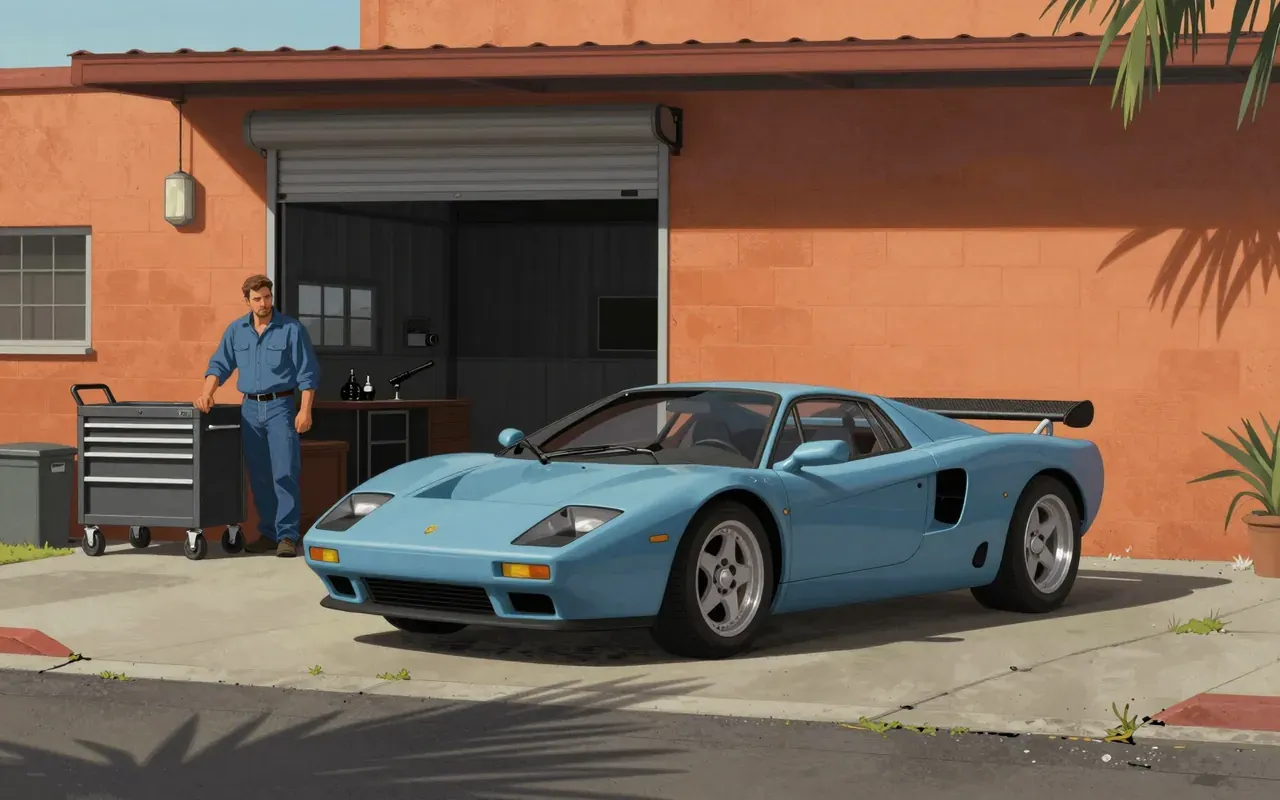
What the car is and where it came from
The CC8S is Koenigsegg’s first production car. It launched in 2002 after eight years of R&D beginning with the 1994 Koenigsegg project. It evolved from the CC prototype. Christian von Koenigsegg and David Crafoord co-created its design concept.
How it works, in terms someone would actually use
It is a mid-engine, rear-wheel-drive targa top sports car. The roof stows in the front trunk. The doors open vertically using dihedral synchro-helix actuation. The exhaust runs centrally and uses the ‘Rocket Cat Principle’.
What it gets right
It gets right the integration of signature hardware into core function: doors that clear tight spaces, a roof that fits where others did not, an exhaust layout that serves both packaging and acoustic intent. It establishes Koenigsegg’s obsession with solving physical constraints with mechanical ingenuity.
What it does not
It does not offer modern driver aids, structural redundancy for crash testing beyond its era, or packaging solutions for daily usability. Its targa system and door mechanism prioritise novelty and compactness over convenience or speed of operation.
What it changed
It proved that a new manufacturer could design and build a complete high-performance car in-house — chassis, suspension, brakes — without legacy infrastructure or major investment. It redefined expectations for startup automakers’ vertical integration.
Who it is for, and who it is not
It is for people who study automotive origin stories, mechanical innovation under constraint, and the material logic of early-2000s supercar development. It is not for buyers seeking usability, resale liquidity, or contemporary performance metrics.
Is it worth your time
Yes — as the first production expression of Koenigsegg’s engineering philosophy, it demonstrates what a small Swedish team built from scratch could achieve in eight years. It is not a benchmark for performance today, but it is a primary source for understanding how the brand defined itself.